

The One Question Every Doctor Should Ask Themselves in December
December always arrives with its peculiar mix of relief and fatigue. The wards feel a little thinner, the rosters a little stranger, and the scent of end-of-year anticipation hangs in the air—mingled, for many of us, with the unmistakable twinge of CPD anxiety.

A Love Letter to Coffee
There are many hundreds drugs circulating through a hospital at any given moment, but only one has helped more careers, steadied more trembling hands, and soothed more existential crises than the rest combined. Let's face it, coffee has probably helped save more lives than penicillin.

Why Junior Doctors Should Choose Osler as Their CPD Home in 2026
Every December and January, thousands of junior doctors find themselves in the same position: scrolling through CPD Home options, comparing costs, tallying requirements, and trying to guess which provider will make their life easiest over the next 12 months.

The Paradox of Expertise
In medicine, experience counts. It sharpens intuition, improves efficiency, and helps us recognise patterns that novices miss entirely. Yet the very qualities that make experience valuable can also make it dangerous.

Emotional Intelligence as a Clinical Skill (Not a ‘Soft Skill’)
Why EI, self-awareness and empathy are shaping the future of medical practice
The most powerful example of emotional intelligence I’ve seen wasn’t directed at a patient at all—it was directed at one of our own.

Learning Across Generations : What Juniors Teach Seniors
There was a moment I realised that teaching in medicine isn’t a one-way street.
It was a busy evening on call, and I was showing a junior doctor how to approach a central venous line. We talked technique, angle, feel, the small adjustments that only come after years of failure and success. As we cleaned up, he paused and said, “Hey, have you seen the new sepsis update? There’s a change in the recommendations for vasopressors”


Be Curious, Not Judgmental: What Ted Lasso Can Teach Doctors About Learning
In one of the most memorable scenes from Ted Lasso, the endlessly optimistic coach challenges Rebecca’s ex-husband Rupert to a game of darts. Rupert, smug and confident, assumes Ted is hopeless.
Alternative Pathways
When I left school, I never imagined I would end up as a doctor. My marks were high enough but I’d never really considered it seriously.
My first plan was to become a journalist. I had an interest in science, so I thought I might become a science teacher instead. Medicine wasn’t even on my radar until a conversation with a friend who was applying to medical school. When I looked at my own subject selections—physiology, biochemistry, anatomy, pathology—it suddenly seemed obvious. Seemingly out of the blue, I decided to give medicine a go. It turned out to be the best decision I ever made.

The Lifelong Learning Value of a Clinical Portfolio for Doctors
Medicine is a profession defined by change. New evidence emerges, guidelines shift, technologies evolve, and patient expectations grow. For doctors, the challenge is not just staying up to date, but making sense of a lifetime of experiences in a way that informs future practice. Without a structured approach, much of this learning risks being lost to memory. A clinical portfolio provides the scaffolding to capture, reflect on, and build from each stage of a doctor’s career.

I Want to Move to Australia – What Do I Do Now?
Australia consistently ranks as one of the world’s best places to live. With its outstanding healthcare system, lifestyle opportunities, and strong economic growth, it’s no wonder that many doctors see Australia as an ideal place to build a medical career.

The Courage to Be Vulnerable: Why Doctors Must Embrace Openness to Learn and Grow
True reflection requires honesty, and feedback only works if we are prepared to truly hear it. Vulnerability is the bridge that makes both possible. When we accept that imperfection is inevitable, feedback stops feeling like an attack and instead becomes a gift that enables growth.

Handover: The Learning You’re Already Doing
Clinical handover isn’t just about logistics. It’s one of the richest learning moments in medicine—you hear how colleagues framed problems, why they chose different pathways, and what they’d do next. That comparison of reasoning is exactly what the CPD framework calls Reviewing Performance → Peer Review.

Junior Doctors: Time to Get Your CPD in Order Before Registration
The registration deadline is fast approaching — doctors must renew by 30 September, just five weeks away. For many, this year’s process will feel slightly different. Alongside the usual steps, those in PGY3 or above in 2025 will need to nominate their CPD Home as part of registration.

Exploring Creative Careers in Medicine
Medicine has long followed well-worn paths: clinical practice, specialist training, research, or hospital-based roles. Yet an exciting shift is underway. Through networks like Creative Careers in Medicine (CCIM)—a community founded by trailblazers such as Dr Amandeep Hansra—health professionals are exploring paths that defy convention, blending clinical passion with artistry, advocacy, education, entrepreneurship, and more.
New Feature Release: Self-Assessments Now Available
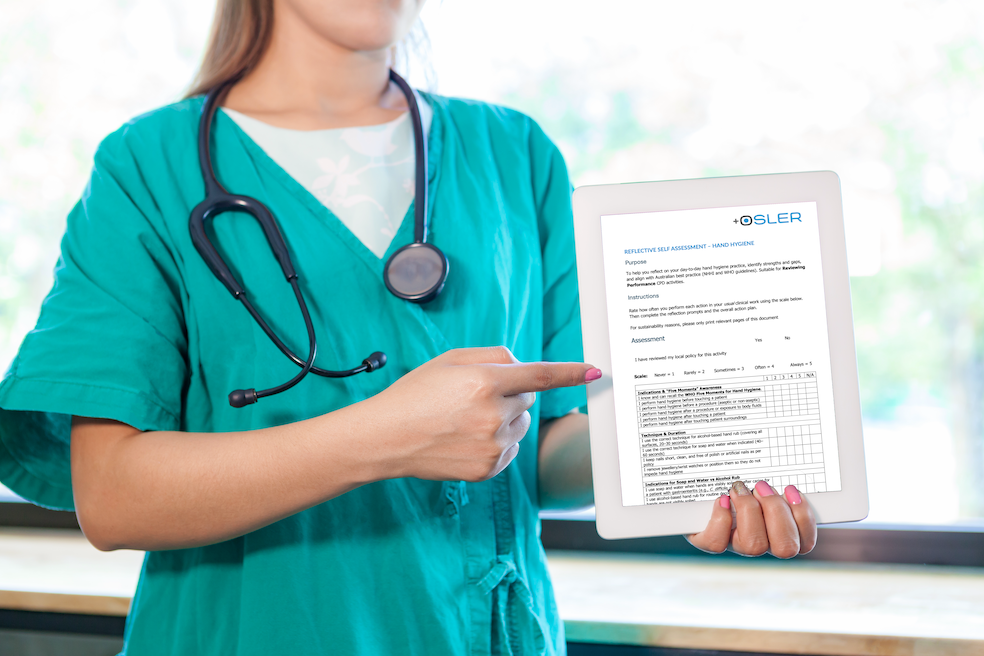
Osler is pleased to announce the release of a new feature designed to help you meet your CPD requirements while also supporting genuine reflection on your own practice: Self-Assessments.

Surviving the Night Shift: Learning When You’re Tired
It’s 3 a.m. in the emergency department. The fluorescent lights hum, your eyes feel like they’ve been sandblasted, and your coffee is more symbolic than functional. Somewhere in the distance, a monitor alarm beeps. You’ve still got four hours to go, and the last thing on your mind is logging CPD.
But here’s the truth: your CPD clock doesn’t care about your roster. It keeps ticking, even through your nights. And while night shifts can make formal learning feel impossible, they can also be rich in unique CPD opportunities — if you know how to capture them.
This is your night-shift CPD survival guide.

Claim It or Lose It: What your CPD can learn from your tax return
If you’ve ever been caught in the mad scramble of end-of-financial-year tax preparation, you already understand the CPD problem. The deadline is looming, you’re sifting through half-remembered receipts, and you’re wondering if you can claim that dinner in April as a “work meeting” or if that subscription really counted as “professional development.”

From Didactic to Dialogic: Why Peer Discussion Beats Lectures
For centuries, lectures have been the dominant teaching method in medicine. Rows of learners, eyes fixed on the presenter, absorbing information delivered in a one-way flow. While this approach can transmit a large volume of material efficiently, it is not how adults—particularly experienced professionals—learn best.

Moving to Australia in 2025? Don’t Forget Your CPD Home
If you're an international medical graduate (IMG) coming to Australia, there's a lot to think about—new systems, new processes, new abbreviations. But one requirement that often slips under the radar is your CPD Home.